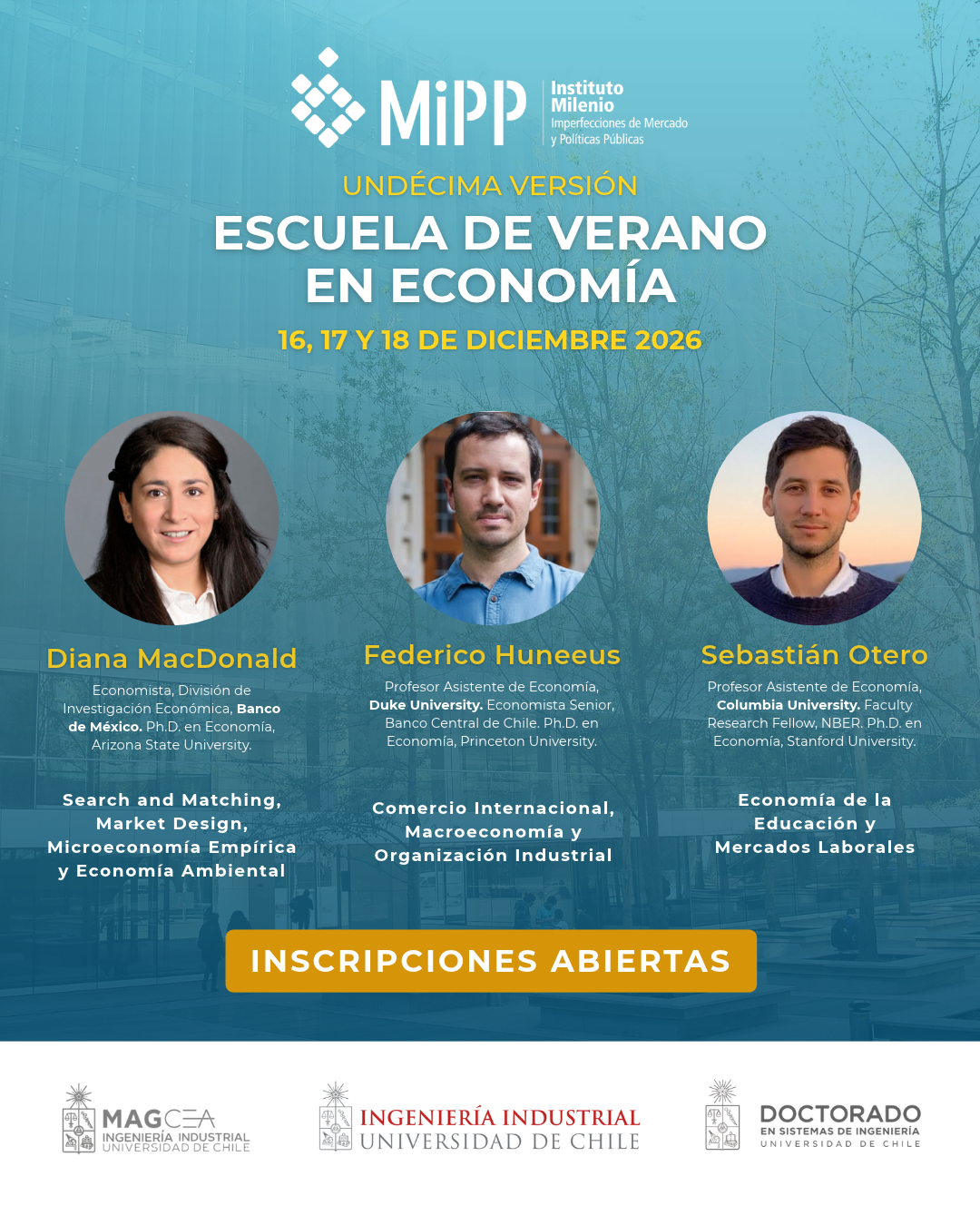
Summer School in Economics 2026
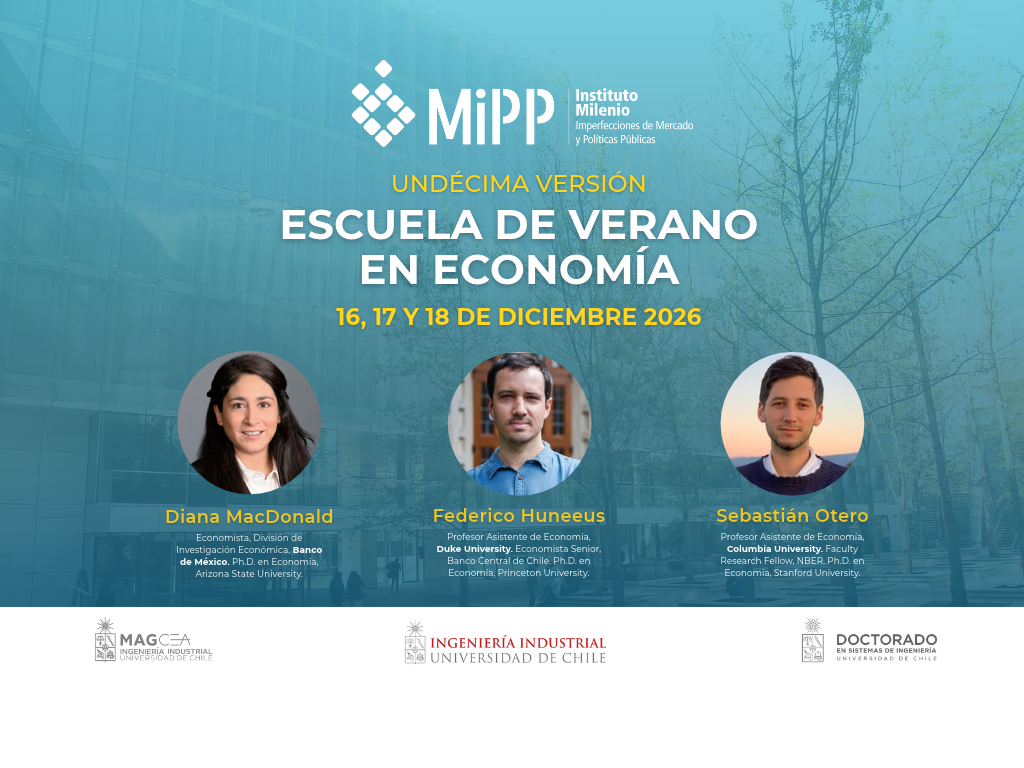
The Millennium Institute for Market Imperfections and Public Policy (MIPP) invites you to the tenth edition of its Summer School in Economics, to be held on Wednesday, December 16, Thursday, December 17, and Friday, December 18, 2026. Over three days, participants will attend intensive courses taught by economists from Banco de México, Duke University and Columbia University, on topics such as matching markets, aggregate productivity and selection models.
The school is aimed at advanced undergraduate students as well as master’s and doctoral students. Each course consists of two sessions and has its own prerequisites.
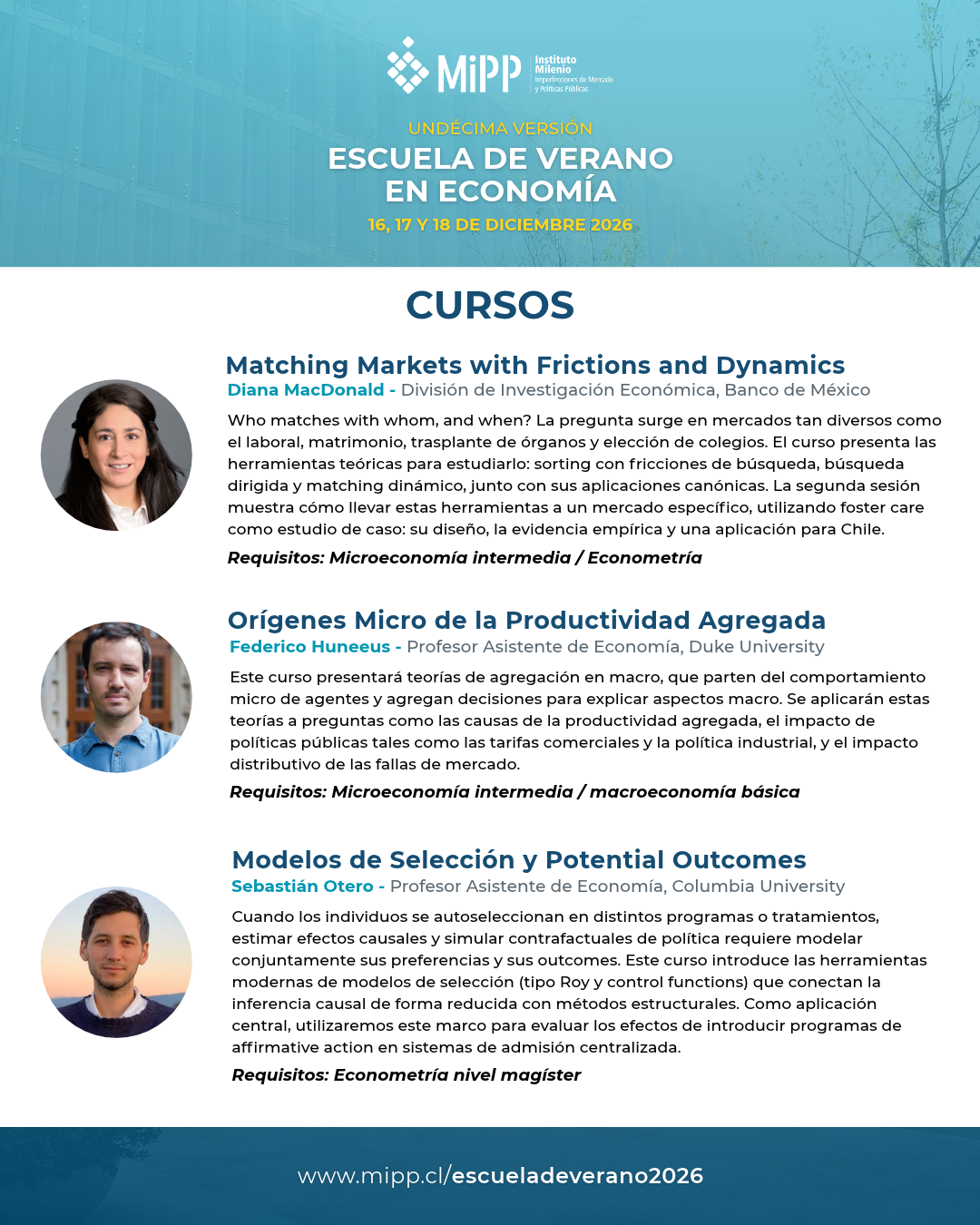
Matching Markets with Frictions and Dynamics
Taught by Diana MacDonald, Economist at the Economic Research Division of Banco de México; Ph.D. in Economics, Arizona State University. Who matches with whom, and when? This question arises in markets as diverse as labor, marriage, organ transplants and school choice. The course presents the theoretical tools to study it, including sorting with search frictions, directed search and dynamic matching, along with their canonical applications. The second session shows how to bring these tools to a specific market, using foster care as a case study: its design, the empirical evidence and an application to Chile.
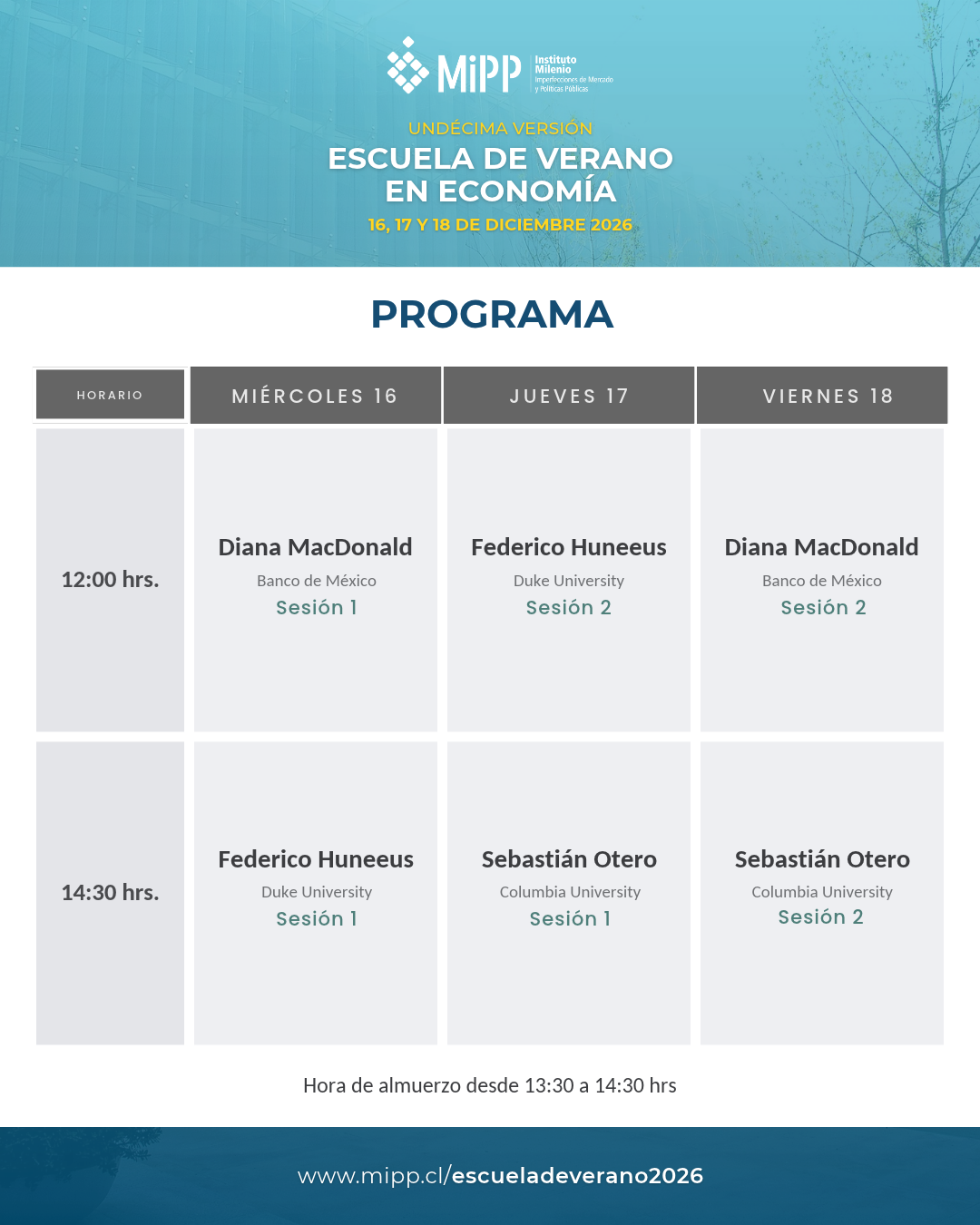
Prerequisites: intermediate microeconomics and econometrics. Sessions: Wednesday, December 16, and Friday, December 18, at 12:00 p.m.
Micro Origins of Aggregate Productivity
Taught by Federico Huneeus, Assistant Professor of Economics at Duke University and Senior Economist at the Central Bank of Chile; Ph.D. in Economics, Princeton University. The course presents aggregation theories in macroeconomics, which start from the micro-level behavior of agents and aggregate their decisions to explain macroeconomic outcomes. These theories will be applied to questions such as the sources of aggregate productivity, the impact of public policies like trade tariffs and industrial policy, and the distributional effects of market failures.
Prerequisites: intermediate microeconomics and basic macroeconomics. Sessions: Wednesday, December 16, at 2:30 p.m., and Thursday, December 17, at 12:00 p.m.
Selection Models and Potential Outcomes
Taught by Sebastián Otero, Assistant Professor of Economics at Columbia University and Faculty Research Fellow at the NBER; Ph.D. in Economics, Stanford University. When individuals self-select into different programs or treatments, estimating causal effects and simulating policy counterfactuals requires jointly modeling their preferences and outcomes. The course introduces modern selection-model tools (Roy-type models and control functions) that connect reduced-form causal inference with structural methods. As a central application, this framework will be used to evaluate the effects of introducing affirmative action programs in centralized admission systems.
Prerequisites: master’s-level econometrics. Sessions: Thursday, December 17, and Friday, December 18, at 2:30 p.m.
Each day includes a lunch break from 1:30 to 2:30 p.m.
Registration is open at https://forms.gle/RcZTZ2AFoHywR3sQA
Gallery